

Many people believe creativity is something you either have or you do not.
They picture artists, musicians, writers, or designers. If they cannot make something impressive, they assume they simply are not creative.
But creativity is not reserved for a few people.
It is the ability to notice possibilities, connect ideas, solve problems, and see familiar things in a new way. You use creativity when you rearrange a room, make up a game, try a new recipe, take a photograph, or find a better way to handle an everyday task.
Creativity can be strengthened.
You do not need hours of free time, expensive supplies, or formal training. You need opportunities to notice, wonder, try, and make.
Here are practical ways to become more creative every day, even if you do not consider yourself artistic.
What Does It Mean to Be Creative?
Being creative does not always mean producing something beautiful.
Sometimes creativity looks like painting, writing, sewing, photography, or music. Other times, it looks like solving a problem, changing your routine, inventing a family tradition, decorating a table, or finding a new use for something you already own.
Creativity is less about the finished result and more about the way you approach the world.
A creative person is willing to ask:
What else could this become?
What would happen if I tried it differently?
What am I overlooking?
You do not need perfect answers. The habit of asking these questions is what matters.
Start by Noticing More
Creativity begins with attention.
When you rush through the day, everything starts to blend together. You see the same streets, rooms, people, and routines without really looking at them.
Slowing down helps you notice details that can spark new ideas.
Pay attention to colours, patterns, shapes, sounds, textures, and small moments that catch your interest. Notice light across the kitchen table, the shape of clouds, a weathered doorway, or rain against a window.
These details give your mind more material to work with.
Try choosing one thing to notice each day. You might look for:
- Three shades of blue
- Interesting textures
- Things shaped like circles
- Signs of the changing season
- Something handmade
- An object you have never noticed before
This simple habit trains you to look beyond the obvious. Over time, you begin collecting ideas without even trying.
Keep a Place for Ideas
Creative ideas often appear at inconvenient times.
You may think of something while washing dishes, walking, or trying to fall asleep. If you do not capture it, the idea can disappear quickly.
Keep one simple place for ideas. It could be a small notebook, a note on your phone, a voice memo, or a document on your computer.
Write down anything that interests you:
- A project you might try
- A phrase you like
- A photo idea
- A question you want to explore
- A colour combination
- A place you want to visit
- A memory you want to preserve
Do not decide whether the idea is good before saving it. Your idea list is not a promise or a to-do list. It is simply a collection of possibilities.
Some ideas will never become anything. Others may grow into a project or adventure later.
Make Creativity Small Enough to Start
One of the biggest barriers to creativity is believing every project needs to be important.
You imagine completing a scrapbook, painting, story, room makeover, or entirely new skill. The idea becomes so large that starting feels exhausting.
Make the activity smaller.
Instead of creating a scrapbook, print one photo and write three sentences about it.
Instead of painting a picture, experiment with three colours on scrap paper.
Instead of writing a story, describe one memory.
Instead of redecorating a room, rearrange one shelf.
Instead of learning photography, take five photos of the same object from different angles.
A tiny creative act still counts.
Small projects reduce pressure, build momentum, and fit more easily into busy seasons.
Create Before You Consume
Many of us begin spare moments by reaching for a screen.
We scroll through photographs, videos, recipes, and other people’s finished work. Inspiration helps, but too much can make your own ideas feel small.
Try creating before consuming.
Before opening social media, spend five minutes writing, sketching, taking photos, arranging something, brainstorming, or working with your hands.
This protects your attention and gives your own thoughts room to appear.
Your creative time does not have to be long. Five focused minutes can feel more satisfying than an hour of collecting ideas you never use.
Build a Simple Creative Routine
Creativity becomes easier when it has a regular place in your life.
You do not need a strict schedule. A creative routine can be connected to something you already do.
For example:
- Write for ten minutes with your morning drink.
- Take one photograph during your afternoon walk.
- Sketch while supper cooks.
- Work on a small project after the children go to bed.
- Add one idea to your notebook before turning off the light.
The goal is not to force yourself to produce something impressive. The goal is to create a familiar doorway into creative thinking.
When the routine is simple and predictable, you spend less time waiting to feel inspired.
Enjoying this article?
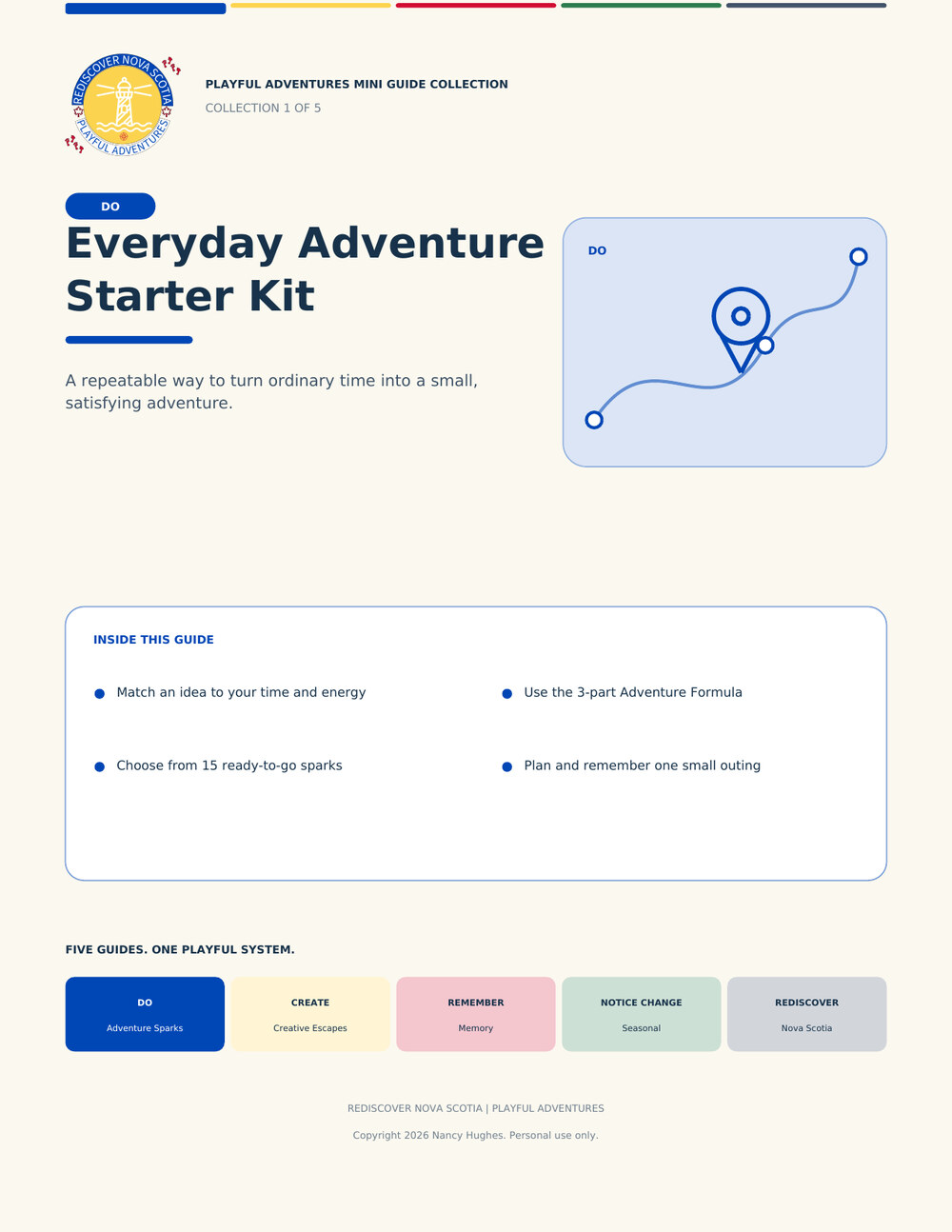
Get the free Everyday Adventure Starter Kit and discover a simple way to turn ordinary time and familiar places into small adventures that fit your life.
Free instant download. Plus monthly emails with playful ideas to explore, create, notice more, and rediscover Nova Scotia.
We respect your privacy. Unsubscribe anytime.
Use Prompts When You Feel Stuck
A blank page can feel overwhelming because it offers too many choices.
Prompts give your creativity a starting point.
Try questions such as:
- What does this season feel like?
- What ordinary object could I photograph in an interesting way?
- What memory from childhood would I like to describe?
- What could I make using only what I already have?
- What would make today feel a little more playful?
- What have I been curious about lately?
You can also create limits.
Choose one colour, one material, one room, one subject, or ten minutes. Limits may sound restrictive, but they often make ideas easier to find.
When every option is available, it is hard to choose. A simple boundary gives your mind something specific to work with.
Try Something You Are Bad At
Adults often avoid activities they cannot do well.
We expect our first attempt to look polished, even when we have never practised. Children rarely have the same concern. They draw, build, sing, dance, and invent freely because the experience matters more than the result.
Give yourself permission to be a beginner.
Try watercolour, collage, baking, photography, sewing, poetry, or another activity that interests you.
Your first attempt may be awkward. That is normal.
Creativity grows through experimentation, not perfection. When you are willing to make something imperfect, you become more open to learning and discovery.
You may also find that being “bad” at an activity is surprisingly relaxing when you stop trying to impress anyone.
Change One Part of Your Routine
New surroundings can spark creativity, but you do not need to travel far.
Small changes wake up your attention.
Take a different walking route. Visit another library. Eat lunch outside. Listen to new music. Move your workspace near a window.
The point is not to make life complicated. It is to interrupt autopilot.
When something changes, your brain pays closer attention. You notice more, compare more, and make new connections.
Even familiar places can feel different when you visit at another time of day or in another season.
Let Yourself Be Bored
Boredom is uncomfortable, so we often fill every quiet moment.
We check messages, scroll while waiting, and reach for entertainment whenever our minds become still.
But empty space gives ideas time to surface.
Try leaving a few moments unfilled. Walk without headphones. Sit outside without bringing anything. Wash dishes without playing a video. Look out the window while waiting for the kettle.
At first, your mind may feel restless. Then it may begin wandering.
Daydreaming allows memories, questions, and unrelated thoughts to connect. Those connections are often where creative ideas begin.
You do not need hours of silence. A few screen-free pockets throughout the day can make a difference.
Use What You Already Have
Creativity does not require constant shopping.
In fact, working with what you already own can lead to better ideas because it gives you useful limits.
Look through drawers, craft supplies, photographs, old cards, natural objects, or unfinished projects.
Ask yourself:
What could I combine?
What could I reuse?
What could I finish?
What could I turn into something else?
You might create a collage, frame a handwritten recipe, turn a walk into a photo challenge, or arrange beach finds in a jar.
Using what you have removes the delay between inspiration and action.
Stop Judging Your Creativity
The fastest way to silence creativity is to judge it too early.
You may tell yourself the idea is silly, the photo is ordinary, the writing is not good enough, or someone else has already done it better.
Those thoughts can stop you before you begin.
Separate creating from evaluating.
During the first stage, let yourself generate ideas, experiment, and make a mess. You can decide what works later.
Ask whether the activity made you curious, helped you notice something, taught you a skill, or gave you a satisfying break from routine.
Those are meaningful results, even when the finished work is not something you would display or share.
A Simple Daily Creativity Practice
If you want to become more creative, try this simple routine:
- Notice one interesting detail.
- Save one idea.
- Make one small thing.
- Leave one quiet moment unfilled.
- Reflect on what you enjoyed.
This practice may take only ten or fifteen minutes.
You can spread it throughout the day. Notice something during breakfast, save an idea at lunch, make something after supper, and reflect before bed.
The routine is intentionally simple. Creativity grows through repetition, not occasional bursts of pressure.
Creativity Is a Way of Paying Attention
Becoming more creative does not require changing who you are.
You do not need to call yourself an artist, buy new supplies, or wait for a perfect stretch of free time.
Begin with the life you already have.
Notice one detail. Follow one curiosity. Save one idea. Try one small thing without worrying whether it will be good.
The more often you make room for creativity, the easier it becomes to recognize it.
You may discover that creativity was never missing. It was simply buried beneath routine, distraction, and the belief that it needed to look impressive.
Creativity is not only about making art.
It is a way of noticing more, imagining more, and bringing a little more curiosity into an ordinary day.